The Laureates

Henri B. Kagan
- Country
- France
- Affiliation
- Université Paris-Sud / Paris-Saclay
- Born
- 1930, Boulogne-Billancourt, France
- Academic background
- PhD, 1960, Collège de France
- Status
- Professor Emeritus
Henri B. Kagan is a pioneer of asymmetric synthesis. His work made foundational contributions to understanding and controlling molecular handedness, and he is widely known for developing chiral ligands for asymmetric catalysis.
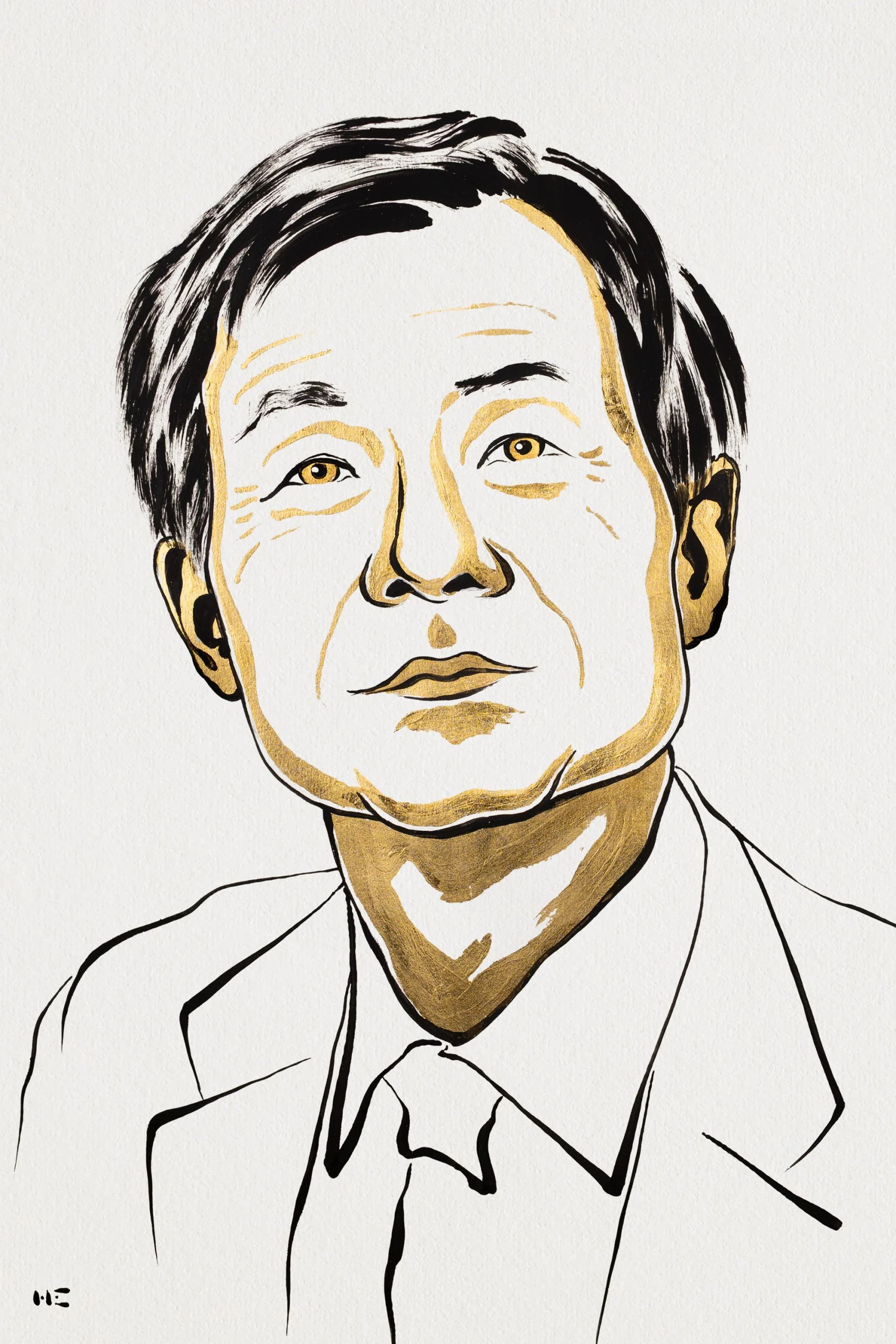
Kenso Soai
- Country
- Japan
- Affiliation
- Tokyo University of Science
- Born
- 1950, Hiroshima, Japan
- Academic background
- PhD, 1979, University of Tokyo
- Status
- Professor Emeritus
Kenso Soai is known for asymmetric autocatalysis. The reaction that bears his name, the Soai reaction, showed how a chiral product can catalyse its own formation and amplify a tiny initial imbalance.
The Chemistry Behind the Nobel Prize
Many molecules exist in two forms that are mirror images of each other. These forms are called enantiomers.
This property is called chirality, from the Greek word for hand. Your left and right hands are mirror images, yet you cannot place one perfectly on top of the other. A glove made for one hand does not fit the other.
Chiral molecules behave the same way: they can exist as two mirror-image forms that cannot be perfectly superimposed.
- Chiral molecule
- Two mirror images
- Enantiomers
Why Asymmetric Synthesis Matters
When ordinary chemical reactions create chiral molecules, they can often produce both mirror-image forms. Chemists therefore developed asymmetric synthesis to favour the formation of one desired enantiomer. This matters especially in:
Pharmaceuticals
Biological systems are chiral, so two mirror-image forms of a molecule can interact with them differently.
Flavours
Enantiomers of a compound can differ in how they are perceived, making stereochemical control valuable.
Fragrances
Mirror-image forms can have different odours, so producing the desired form matters.
Agricultural chemicals
Chirality can influence how a molecule behaves, so selective synthesis of one form is useful.
Advanced materials
Specialised materials and chemical products can depend on a defined molecular handedness.
Henri B. Kagan: Understanding Non-Linear Effects
In a simple picture, you might expect the purity of a chiral product to rise in direct proportion to the purity of the chiral catalyst or auxiliary used to make it. That is a linear relationship.
Kagan demonstrated that this is not always so. In some systems, a small imbalance in chirality can lead to a much larger imbalance in the products than a simple linear relationship would predict. These are called non-linear effects.
This became an important tool for chemists: it helps in interpreting how asymmetric catalysts work and in designing asymmetric reactions.
- Small chiral imbalance
- Non-linear amplification
- Stronger preference for one enantiomer
Kenso Soai: The Power of Autocatalysis
In an autocatalytic reaction, a product of the reaction helps catalyse the formation of more of that same product.
Soai's work demonstrated a remarkable example of asymmetric autocatalysis, now known as the Soai reaction. Here the product is chiral, and it catalyses its own formation in a way that favours its own handedness. A very small initial imbalance can therefore be amplified.
This work became especially important in discussions about how molecular asymmetry, and ultimately homochirality, might arise.
- Small initial chiral imbalance
- Chiral product forms
- Product acts as catalyst
- More of the same chiral form forms
- Chirality is amplified
The Mystery of Homochirality
Living systems are strongly biased toward one molecular handedness. For example, the amino acids in proteins are predominantly found in one enantiomeric form.
How could such molecular asymmetry emerge?
The discoveries recognised by the 2026 Nobel Prize provided important chemical tools and insights relevant to this long-standing puzzle. They show how a small imbalance can, in principle, be amplified by chemistry itself.
- 1Molecular symmetry
- 2Small asymmetry
- 3Non-linear effects
- 4Autocatalysis
- 5Amplified chirality
- 6Homochirality
Why the 2026 Nobel Prize Matters
Pharmaceutical Chemistry
Controlling molecular handedness is important when designing molecules that interact with biological systems.
Organic Synthesis
Asymmetric synthesis lets chemists selectively produce the desired enantiomer.
Origin of Homochirality
The Soai reaction has inspired research into how molecular handedness could emerge.
Flavours & Fragrances
Different enantiomers can have different properties, making stereochemical control useful.
New Materials & Chemicals
Asymmetric synthesis can also contribute to the preparation of specialised materials and chemical products.
Plain-language summary
In Simple Terms
Imagine that chemistry can make both a left-handed and a right-handed version of a molecule. Kagan showed how chemical reactions can strongly favour one side, while Soai demonstrated how a chiral product can help create more of the same handedness. Together, these discoveries helped chemists understand and control molecular asymmetry.
Nobel Prize 2026 — Key Facts
Award
Nobel Prize in Chemistry
Year
2026
Laureates
- Henri B. Kagan
- Kenso Soai
Countries
- France
- Japan
Scientific field
Asymmetric Organic Synthesis
Key concepts
- Non-linear Effects
- Autocatalysis
- Chirality
- Homochirality
Prize
12 million Swedish kronor, shared equally
Citation
“For the discovery of non-linear effects and autocatalysis in asymmetric organic synthesis”
A Journey Toward Understanding Molecular Handedness
Early understanding
Molecular chirality recognised
Asymmetric synthesis
Methods to favour one enantiomer
Kagan
Work on non-linear effects
Soai
Discovery of asymmetric autocatalysis
Homochirality
Growing research into its origins
2026
Nobel Prize in Chemistry
A New Way to Think About Molecular Handedness
The work of Kagan and Soai gave chemists powerful tools for understanding and controlling chirality, and helped illuminate one of chemistry's long-standing questions: how molecular handedness arises and how it can be amplified.
Chemistry does not always produce a perfect mirror image. Sometimes, a tiny imbalance can become the beginning of something much larger.